Year 9
IN THIS LESSON
National
Curriculum
Links
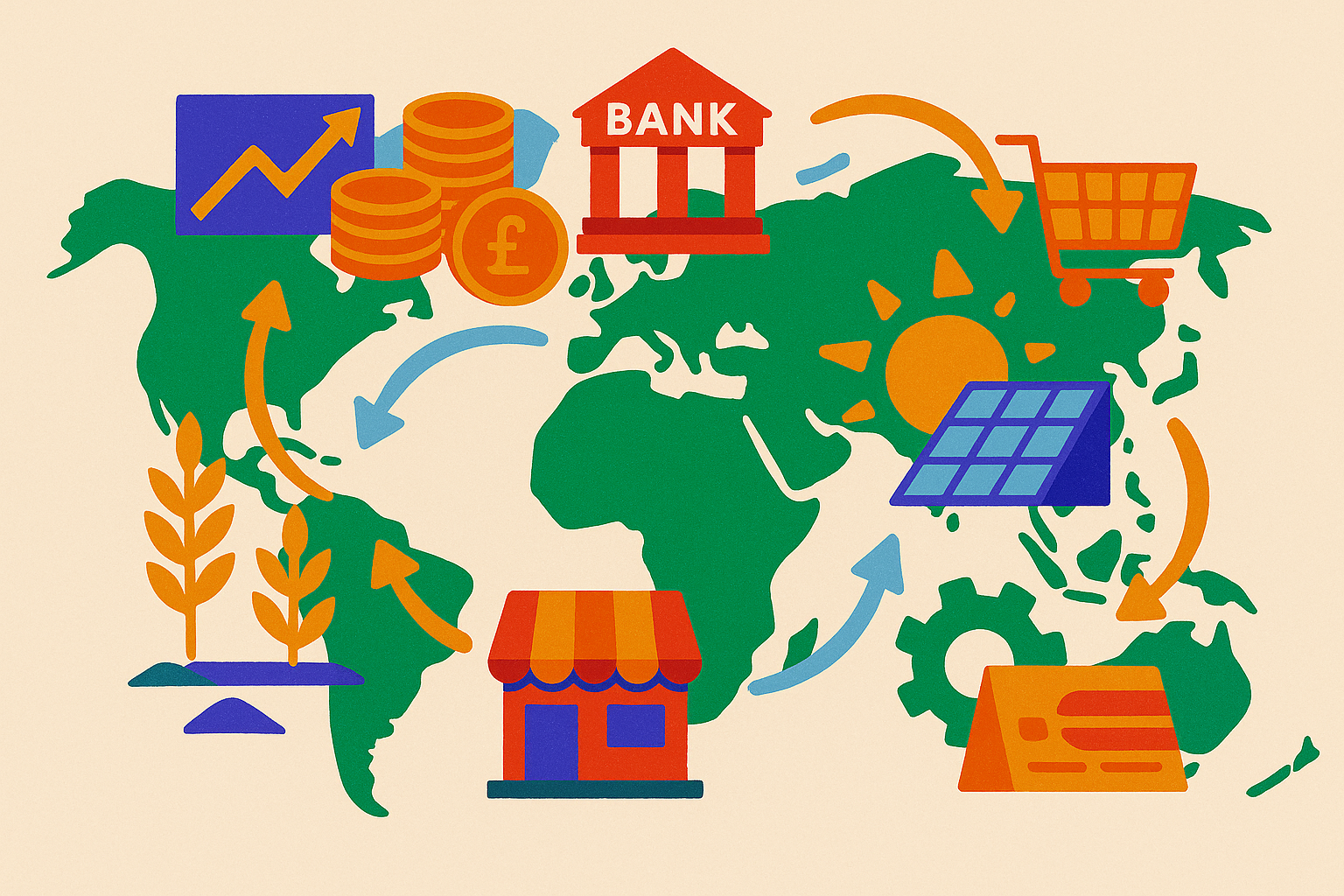
In this lesson students will explore how money shapes fairness, opportunity and power on a global scale . They will compare wealth across countries, examine financial inclusion and consider how access to banking, credit and savings can widen or reduce inequality. Through discussion and image analysis they will investigate how money influences ethics, sustainability, labour conditions and the ability of ordinary people to create change. By the end students gain a richer understanding of how financial systems impact real lives and how ethical finance can support a fairer world.
Maths:
PSHE:
This lesson supports the National Curriculum for Mathematics by enabling pupils to reason mathematically through interpreting and comparing proportional data in real world contexts. Pupils analyse wealth per person across countries, compare levels of financial inclusion, rank proportional data sets and draw evidence based conclusions about inequality. Mathematical reasoning is applied to evaluate fairness, distribution and long term impact using comparative data.
This lesson supports PSHE Living in the Wider World objectives LWW8 and LWW9 by helping pupils understand ethical and sustainable financial decision making and explore how personal and global financial choices affect individuals, communities and wider society. Pupils evaluate the relationship between money, power and inequality, consider the social and environmental impact of financial systems, and reflect on how responsible financial behaviour can promote fairness, opportunity and sustainability.