Year 8
IN THIS LESSON
National
Curriculum
Links
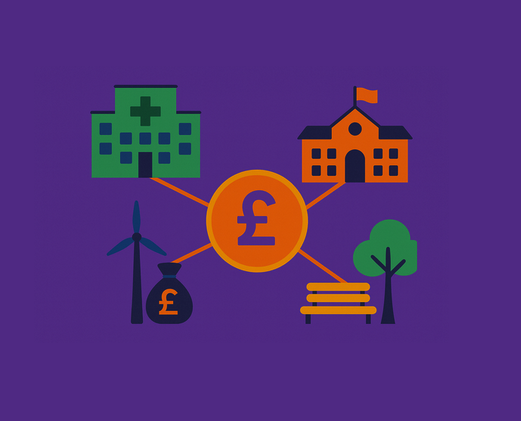
In this lesson students will learn why taxes exist, how they fund the services everyone relies on, and what happens when too few people contribute. They’ll explore ideas like public goods, the free rider problem, and different views of fairness, then take on the role of a government cabinet to decide how to allocate a national budget. By weighing trade-offs and defending their choices, students deepen their understanding of how shared contributions keep society running.
Maths:
PSHE:
This lesson supports the National Curriculum for Mathematics by enabling pupils to reason mathematically about fairness, proportion and risk within real world financial contexts. Pupils apply percentages and proportional thinking when reallocating budgets, calculating sector spending and modelling the impact of reduced tax contribution. They use quantitative reasoning to evaluate consequences and justify decisions using numerical evidence.
This lesson supports PSHE Living in the Wider World objectives LWW8 and LWW9 by helping pupils understand ethical and sustainable financial decision making, including the role of taxation in funding public goods. Pupils explore how personal financial contributions affect individuals, communities and wider society, evaluate fairness through different perspectives, and reflect on the social responsibility involved in balancing individual benefit with collective wellbeing.