Year 10
IN THIS LESSON
National
Curriculum
Links
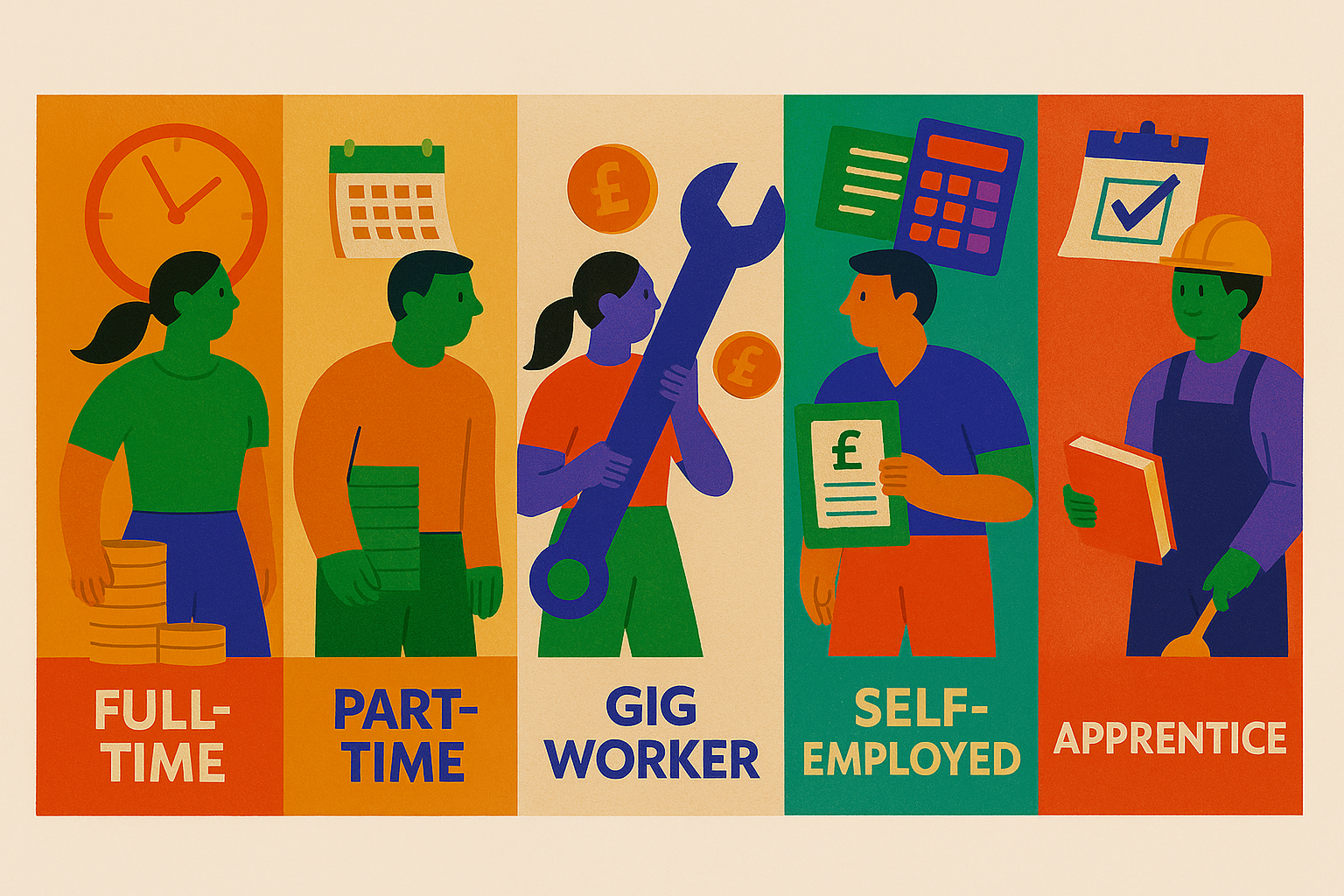
In this lesson students will explore how different types of work shape both what people earn and what they are entitled to receive . They will compare full time, part time, gig work, self employment and apprenticeships, using real profiles to spot the clues that define each role. They will learn how tax codes, National Insurance and pension contributions affect take home pay and why payslips look different depending on employment status. Through discussion they will consider fairness in the system and how rights, security and deductions vary across the workforce. By the end students have a stronger grasp of how employment choices link directly to income, protections and long term financial wellbeing.
Maths:
PSHE:
This lesson supports the National Curriculum for Mathematics by enabling pupils to interpret percentages and ratios in financial deductions, calculate net pay from gross pay, and apply proportional reasoning when analysing pension contributions and tax codes. Pupils use numerical evidence to compare employment types, evaluate how deductions affect take home pay, and reason mathematically about long term financial impact.
This lesson supports PSHE Living in the Wider World objectives LWW4, LWW5 and LWW6 by helping pupils understand employment rights and responsibilities, including tax, pensions and National Insurance. Pupils explore different types of employment and how these affect income security, benefits and deductions, develop skills in managing income, and prepare for adult financial life by evaluating fairness, entitlement and long term planning.